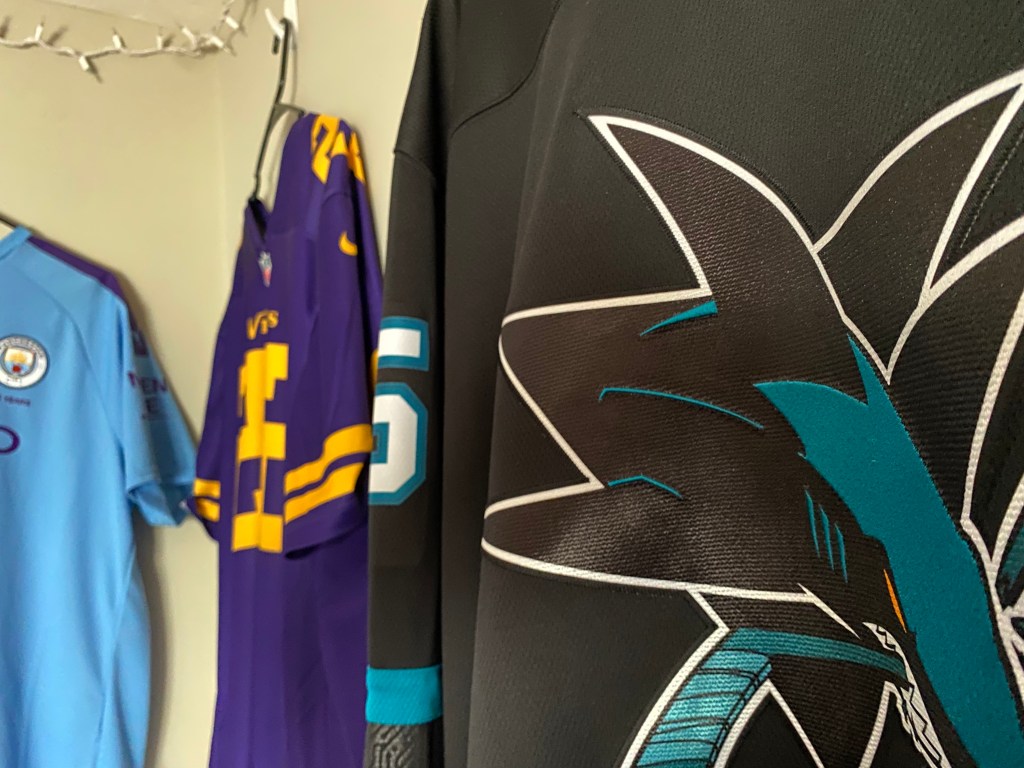
Anton Lee proudly joins his Zoom interview sporting a white and orange Cleveland Browns jersey.
“You catch the game yesterday?” Lee said, grinning. “Fields never stood a chance.”
Lee, 21, is a diehard Cleveland sports fan. The only problem? He doesn’t live in Cleveland.
Lee is like over half of North American sports fans, displaced from his favorite teams’ home area. He says that he grew up a fan of Cleveland sports, because of his father.
“My dad was the only one who ever put on sports. My mom would occasionally, but usually is my dad. And whenever my dad watched sports, it was always one of those teams,” Lee said. “And I kind of understood the story of how [Cleveland teams] were never that good and that kind of stuff. I didn’t want to switch it up because those are my teams. I have some loyalty when it comes to it.”
Arthur A. Raney is a professor at Florida State, where he examines why people enjoy certain forms of media and entertainment. One of the reasons that humans enjoy sport and the act of watching sport, Raney says, is to find a common ground in a social setting. “The emotional highs and lows occurring over the course of a game or match, are part of the appeal of sporting events,” Raney says in his 2004 article entitled “Motives for Using Sport in the Media: Motivational Aspects of Sport Reception Processes.”
People enjoy watching sports, and they enjoy watching them with fellow fans.
The issue for Lee is that he lives in the Bay Area.
Finals heartbreak, followed by a miracle
2015 began the first of four successive NBA Finals between Lee’s Cleveland Cavaliers and his hometown’s Golden State Warriors. Lee says that the 2016 NBA championship was all that much sweeter because of the circumstances under which the Cavaliers won.
“I remember thinking, the Cavs just won and I ran outside, I started crying and I call my dad. And then I call my akong, he’s my grandfather, who has lived in Cleveland since the 1950s. I thought he was gonna die and would never see a championship,” Lee said. “But I was so happy that he did.”
Lee endured a lot of flack from friends and Bay Area residents for celebrating when the Cavs won the 2016 title. But he has never forgotten the feeling.
“If I’ve ever had a bad day, if I ever watched Baker Mayfield for like four interceptions, do you know what I think about? The day the Cavs won,” Lee said. “And you know what, at least we got that one.”
There is an unspoken communication between sports fans, and Lee says that applies even more for sports fans that are from “losing” cultures like Cleveland. Despite years of disappointment, Lee doesn’t let it get him down.
A University of Kansas study that showed “sports fans are happier and actually suffer fewer bouts of depression and report lower levels of alienation than people who are not interested in sports. In fact, most sports fans are high functioning, well educated and successful people.”
In Lee’s words, the Cavs repaid “every one of those games that [he] watched and saw them get just pummeled, every time [he] saw the Celtics clown on LeBron [James], all those games, they meant to something in the end; they made the victory that much sweeter.”
Man over team
Most people follow a team, but Caleb Talbot chooses a player.
“I usually just follow Russell Westbrook the player so pretty much whatever team he’s on. So I guess that would be the Lakers now,” Talbot said.
Talbot has driven down from northern Maine to TD Garden to watch Westbrook, some nine-hour round trip.
“I’ve liked him since 2009 or 2010, somewhere around there. It’s just the intensity that he brings and how much he consistently puts in the effort,” Talbot said. “He’s not great at really one specific thing in the game. He’s good at everything.”
“It’s not like I was a fan of LeBron back when he was with Miami,” Talbot said. “One of my friends took a lot of heat for that. People generally don’t hate Westbrook here, but they do give you a weird look when you say you like a player and not a team.”
Two different perspectives from fans revolving around a game that is otherwise meaningless. It’s a testament to how much impact sports have on people’s lives and not just the teams that are in one’s local area.
 Jeremy Guerin